Back to Research

Rheology and Aging of Protein Condensates

Biological Condensates

Biological condensates are created by the liquid-liquid phase separation in the cells. Traditionally, the notion of phase separation was applied only to non-living systems. However, this perspective changed dramatically with the discovery of P granules in the C. elegans germline, highlighting the critical role of liquid-liquid phase separation in living cells. Liquid-liquid phase separation is a process where a homogeneous solution divides into two separate liquid phases, similar to how oil separates from water. In biological systems, this phenomenon leads to the formation of membrane-less organelles, which are dynamic cellular compartments without lipid bilayers, commonly known as biological condensates.

Research has shown that protein condensates, which start off dynamic and fluid, gradually transition into a more solid-like state with slower dynamics over a period of several days. This slow relaxation process is akin to the behavior of glass, which is inherently a non-equilibrium process. Comprehending this material characteristic is vital, as it represents the time-dependent evolution of the rheological properties of protein condensates.

How could nonequilibrium processes such as material aging and active processes from molecular motors play a role in the rheological properties of biological condensates? My current projects are focused on the interaction between nonequilibrium processes and rheological properties of biological condensates.

Associated Publications

Sequence complexity and monomer rigidity control the morphologies and aging dynamics of protein aggregates
R. Takaki and Dave Thirumalai.
Proceedings of the National Academy of Sciences 121.50 (2024), e2409973121.
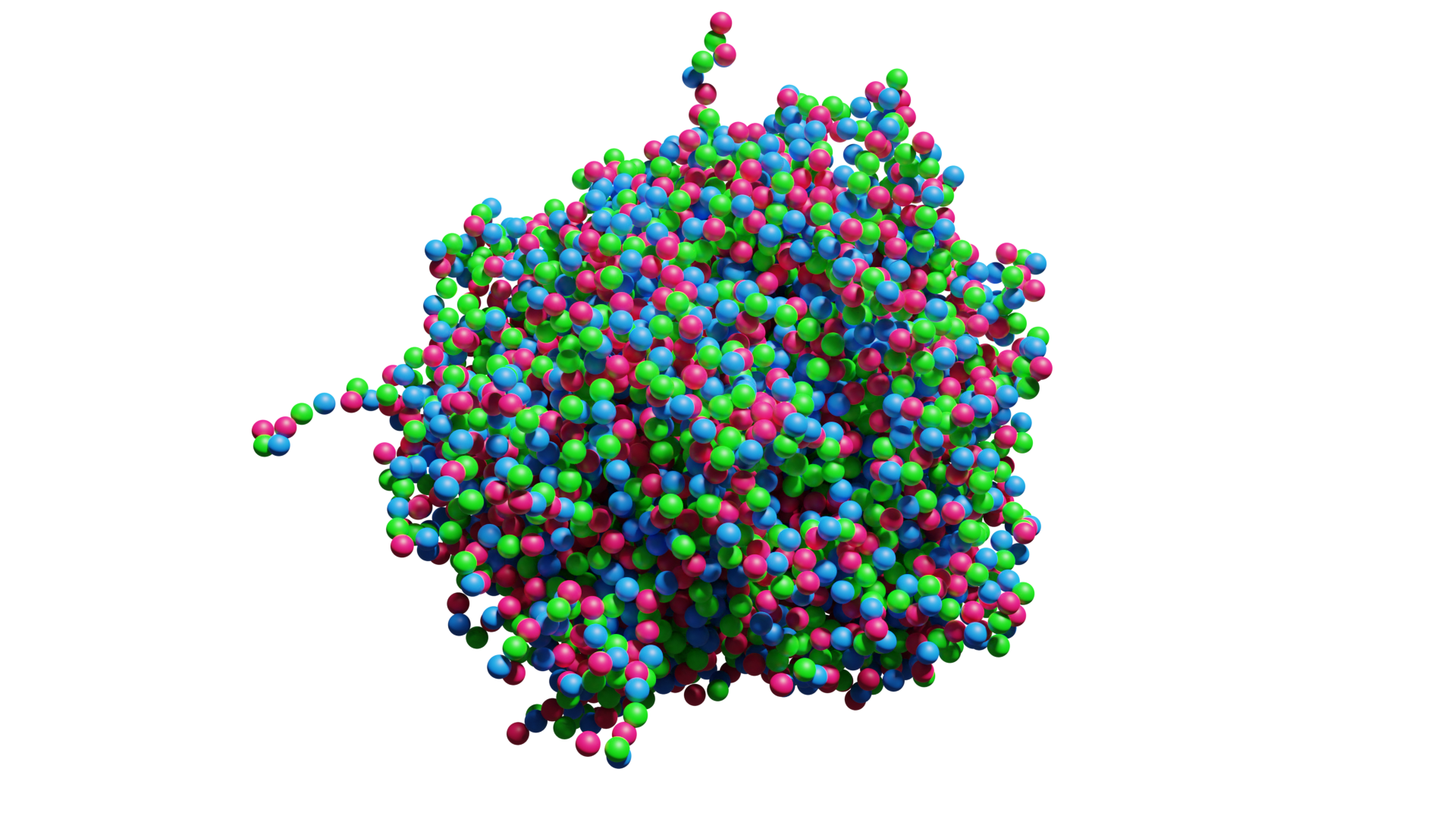
In this study, we introduce a minimal simulation model demonstrating that monomer sequence complexity and structural rigidity dictate the morphology and aging dynamics of protein condensates, mapping the abrupt transition from liquid-like droplets to non-ergodic amyloid structures.
Read Paper
Theory of Rheology and Aging of Protein Condensates
R. Takaki, Louise Jawerth, Marko Popović, and Frank Jülicher.
PRX Life 1 (Aug. 2023), p. 013006.
We developed a quantitative, trap-based rheological model that successfully reproduces the age-dependent relaxation time of biological condensates, establishing a theoretical framework to explain how initially liquid-like protein droplets gradually age into highly viscous, glassy states.
Read Paper
Fibers and Glasses are Competing Material States in FUS Protein Condensation
Liru Feng, Iain Muntz, R. Takaki, Lionel Ndamba, Martine Ruer-Gruß, Frank Jülicher, and Louise Jawerth.
Under review (2025).
We directly observe and theoretically describe competitive aging pathways in Fused in Sarcoma (FUS) condensation. Our findings reveal that amyloid fibers and glassy condensates are distinct, coexisting solid-like phases that form via different pathways connected by phase separation kinetics and do not directly interconvert.